Built by 
Get Ready for
Get Ready for
MCP
The Model Context Protocol is rewriting how AI agents connect to your systems. Every SaaS platform will soon have thousands of autonomous agents. Is your organisation ready to govern them?
The Model Context Protocol is rewriting how AI agents connect to your systems. Every SaaS platform will soon have thousands of autonomous agents. Is your organisation ready to govern them?
MCP (Model Context Protocol) is the open standard that lets AI agents talk to your tools, APIs, and data through a single, uniform interface. Every major SaaS platform is racing to support it, and autonomous agents are about to outnumber human users on your systems. MCP solves connectivity. Pairing it with agent-native identity solves governance. If you don't have a plan for both, you're scaling risk.
The Model Context Protocol is an open standard that defines how AI agents communicate with tools, APIs, and data sources. It\u2019s being adopted by every major AI platform \u2014 and it changes everything.

MCP is the open standard that lets AI agents communicate with tools, APIs, and data sources. Think of it as USB-C for AI — one protocol, every connection.

Before MCP, every agent-to-tool connection was custom-built. MCP standardises the interface so agents can discover, negotiate, and interact with any MCP-enabled service.

MCP marks the moment AI agents stop being assistants and start being autonomous actors. They browse, execute, decide, and build — across your entire ecosystem.
The gap between piloting agents and deploying them isn't a technology problem. It's a governance problem.
Traditional identity systems rely on MFA, CAPTCHAs, and manual provisioning — workflows agents can’t complete. Teams bypass security entirely.
Without delegated authority and clear ‘on-behalf-of’ flows, platforms risk compliance failures, data exposure, and regulatory issues.
Agents operate autonomously, across domains, at machine speed. Existing IAM can’t handle the scale, speed, or dynamism.
Why identity built for humans can't govern agents operating at machine scale.
| Dimension | Traditional IAM | MCP-native identity |
|---|---|---|
| Built for | Humans | Agents and humans, at parity |
| Authentication | Passwords, MFA, CAPTCHAs | Cryptographic credentials, scoped tokens |
| Provisioning | Manual, ticket-based | Automated, policy-driven |
| Audit trail | User action logs | Agent action logs plus delegation chain |
| Scale | Thousands of users | Millions of agents |
| Speed | Human pace | Machine pace |
| On-behalf-of flows | Impersonation or shared credentials | Delegated, verifiable authority |
MCP unlocks powerful agent capabilities. But without identity and governance, every connection is a liability.

Your CRM deploys an AI agent that autonomously qualifies leads, updates records, and triggers workflows across Slack, HubSpot, and your billing system.
Without governed MCP connections, this agent has unchecked access to customer data across every integrated platform.
With MCP-native identity, every action is attributable, scoped, and auditable — the agent operates within defined boundaries.

Procurement, logistics, and finance agents negotiate contracts, track shipments, and process payments — coordinating across organisational boundaries.
Agents operating across trust boundaries with borrowed credentials create uncontrolled access sprawl.
Federated MCP authentication lets agents traverse ecosystems with verifiable, scoped credentials — no shared secrets.
An agent continuously monitors regulatory changes, updates internal policies, and triggers remediation workflows across your tech stack.
A compliance agent with write access to policy systems and no audit trail is itself a compliance risk.
Agent identity with lifecycle controls ensures every policy change is traceable, approved, and reversible.
“Thinking MCP is a ‘nice-to-have’ integration layer is a mistake. It’s an identity problem at scale. Every agent, every API, every human needs to be authenticated and controlled on the same footing.”
— Simon Russell, CTO, Prefactor
Every organisation is somewhere on this curve. Take the assessment to find out where you are — and what it takes to move forward.
Answer a few questions about how your organisation handles AI agents today. You'll get your maturity stage and what to focus on next.
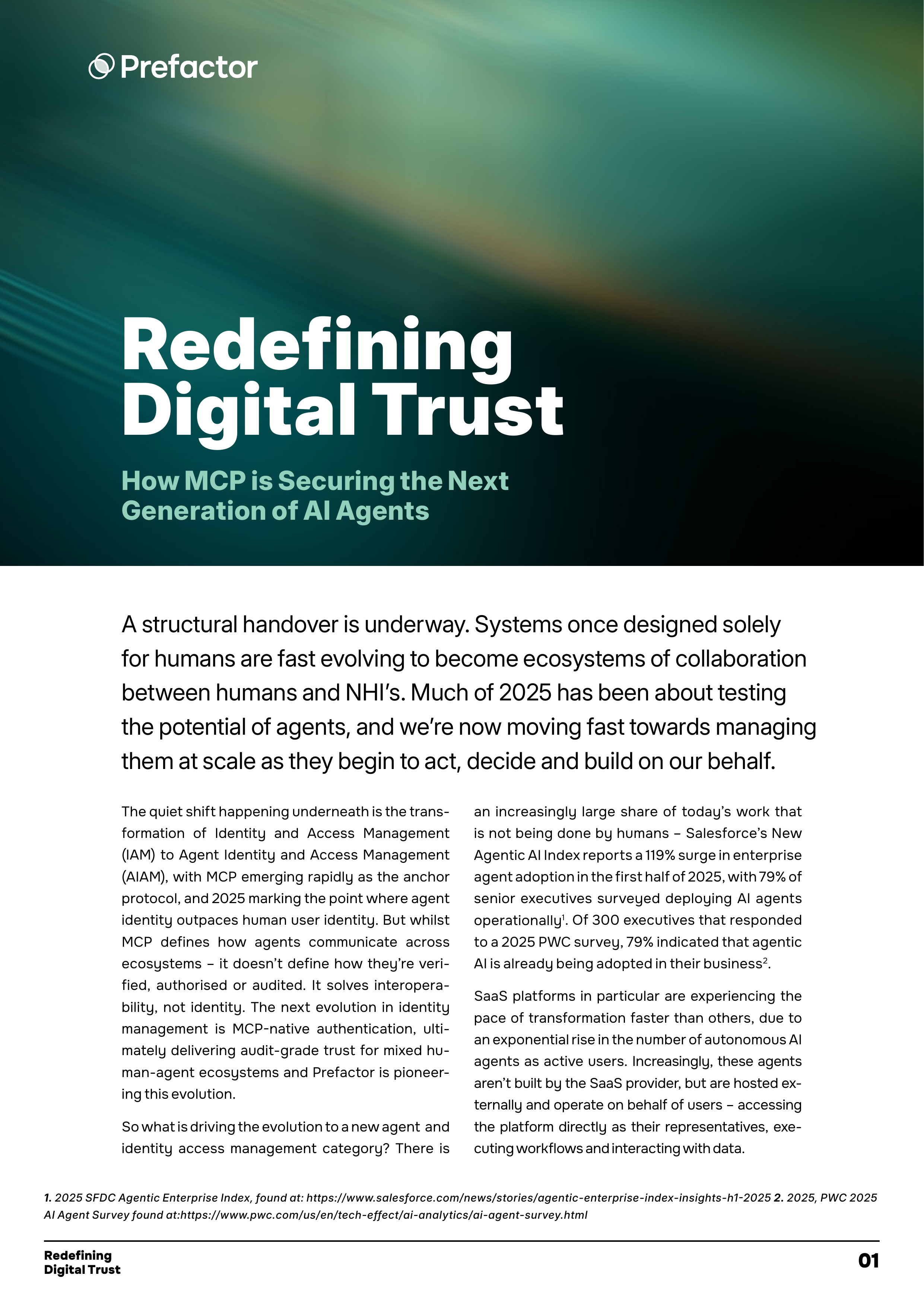
How MCP is Securing the Next Generation of AI Agents
The definitive guide to the shift from IAM to Agent Identity and Access Management. Backed by data from IBM, Salesforce, Gartner, and real breach analysis.
Prefactor helps enterprises close the gap between AI experiments and AI agents in production. We build the governance frameworks, control planes, and operational infrastructure that move organisations from Stage 1 to Stage 4.
This is our open resource — raising the bar for how enterprises think about agent governance before they deploy.
Learn more about Prefactor →Authentication and governance built directly into the protocol layer where agents operate
Centralised registry, lifecycle management, and policy enforcement for every agent
Governed, auditable agent-to-tool connections via MCP at enterprise scale
From MCP prototype to production in weeks, not quarters
Direct answers for technical leaders evaluating MCP adoption.
MCP (Model Context Protocol) is an open standard that lets AI agents communicate with tools, APIs, and data sources through a single, uniform interface. Think of it as USB-C for AI — one protocol, every connection. It was introduced by Anthropic in late 2024 and is now being adopted across the major AI platforms.
MCP is reshaping how AI agents connect to enterprise systems. Without it, every agent-to-tool integration is custom-built and ungoverned; with it, agents can discover and interact with your systems through a standard, auditable interface. The catch: MCP solves connectivity but not identity — so early adopters need to pair it with agent-native identity controls.
Agent identity is the set of credentials, permissions, and lifecycle controls that govern what an AI agent can do — on whose behalf, with what scope, and under what audit trail. Traditional IAM was built for humans: MFA, CAPTCHAs, manual approvals. Agents can't complete those workflows, so teams either bypass security or give agents over-privileged credentials. That is how the majority of AI-related breaches happen.
Start with the free MCP Readiness Assessment on this site. It scores you across four maturity stages — Unaware, Exploring, Integrated, Orchestrated — and returns a tailored next-step plan. For a deeper read, download the Redefining Digital Trust white paper, which maps the shift from IAM to Agent Identity & Access Management (AIAM).
CTOs and CISOs own the governance architecture. Platform and identity teams design the controls. Engineering leadership decides which internal APIs to expose via MCP. And if you buy SaaS from vendors adding agentic features (Salesforce, HubSpot, Slack, and similar), procurement and security need to evaluate each vendor's MCP posture before renewal.
Get frameworks, playbooks, and insights on agentic governance delivered to your inbox.
No spam. Unsubscribe anytime. A resource by Prefactor.